
Press Conference Case Sharing: Lung Cancer Screening Survey, Cost-Effectiveness Study, and Policy Recommendations
- Prologue Editorial

- Oct 28, 2025
- 3 min read
Updated: Dec 18, 2025
The latest Policy Address proposes strengthening cancer screening technologies and commissioning local universities to explore the use of AI-aided lung cancer screening to consolidate Hong Kong’s leading position in cancer research, prevention and control. The Secretary for Health also highlighted the recent rise in lung cancer among non-smokers and women, noting that lung cancer screening will focus on high-risk groups to ensure rational use of medical resources. Team Prologue strategized a press conference for concern group and two doctors, publicizing their localized research and advocacy regarding lung cancer screening and treatment.
The press conference featured first-time release of two insightful academic studies: Prof. Martin Wong, the Jockey Club School of Public Health and Primary Care, Faculty of Medicine, The Chinese University of Hong Kong (CUHK), presented a public opinion survey on Hong Kong people’s acceptance and awareness of low-dose computed tomography (LDCT) lung cancer screening. Dr. Herbert Loong, Clinical Associate Professor, Department of Clinical Oncology, CUHK, shared a cost-effectiveness analysis of including high-risk non-smokers in LDCT lung cancer screening. ASPIRE for Lung Cancer, a concern group, shared its expectation on the implementation of universal lung cancer screening in Hong Kong.
This significant public health topic yielded media coverage from multiple mainstream outlets including Oriental Daily News, on.cc, am730, Hong Kong Economic Times, as well as health platforms like Oriental Sunday and healthyD.

CUHK survey: 90.1% of respondents support lung cancer screening
Prof. Wong presented a CUHK public opinion survey conducted from April to May 2025, which included 1,100 survey respondents and in-depth interviews with 30 respondents to assess acceptance and awareness of LDCT lung cancer screening. The survey showed that the public holds a generally positive attitude: 90.1% of respondents expressed support for lung cancer screening, and 88.4% considered it feasible.
He noted that while quantitative findings show extensive public support, the next key step is encouraging more people to participate in screening to achieve early identification and treatment goals. In-depth interviewees typically felt that support from doctors, the government, and family members is crucial, whereas lack of knowledge and high costs are the main barriers; willingness to participate increases when there is health insurance or financial aid, family encouragement, and easy access to information. He believes that these findings shed light on citizens’ incentives and help the government refine the screening strategy.
Joint research by CUHK and HKU: LDCT screening is cost-effective for high-risk non-smokers
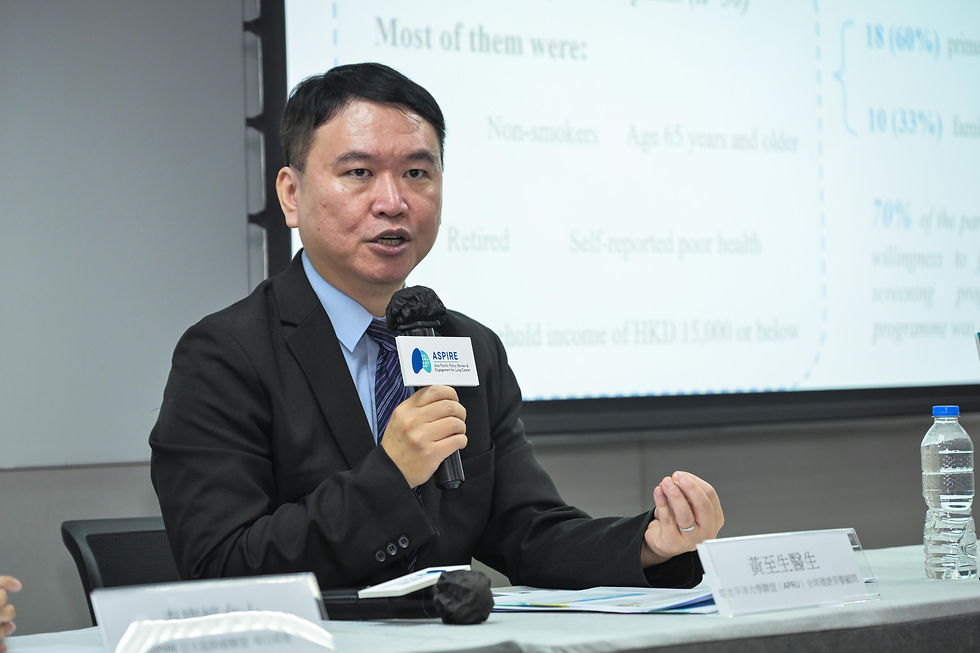
Lung cancer is the top cancer killer in Hong Kong, and nearly half of local lung cancer patients are non-smokers, underscoring the need for a localized screening strategy. Family history, among exposure to second-hand smoke, kitchen fume and air pollution, are risk factors that one shouldn’t neglect. The joint research by Dr. Loong and the University of Hong Kong found that LDCT screening is cost-effective for both smokers and high-risk non-smokers, with even more favourable cost-effectiveness in the high-risk non-smoking group.
Dr. Loong pointed out that LDCT lung cancer screening significantly increases early detection of lung cancer and reduces mortality. The high-risk groups identified and assessed under this study not only include heavy smokers, but also people with a family history of lung cancer, long-term exposure to second-hand smoke, and frequent inhalation of cooking fumes.

ASPIRE welcomes the Government’s initiative to promote AI-assisted lung cancer screening. Given the cost-effectiveness of LDCT for high-risk non-smokers, it is recommended that high-risk non-smokers, especially those with lung cancer family history, be included in the LDCT pilot programme, to enable early diagnosis and treatment. It is also suggested that psychological support and patient education should be incorporated into screening programmes to enhance public participation.


📍Media Coverage Highlight:


Comments